The selections for the 2016 Paterson Poetry Prize (announced here by Maria Gillan) are as good a line-up as I’ve seen from any poetry prize in recent memory. Each book is one I want to have, starting with the winner, Mark Doty’s Deep Lane, of which the announcement says:
“In Deep Lane, Mark Doty writes of “the wild unsayable,” yet manages in this brilliant book to find the precise words to describe what it means to be alive and human with all our flaws. He leads us on a brave journey through grief and loss and joy, to all that lies below the surface of our lives, all the hard-earned moments that redeem us.”
Any new book from Mark Doty is a cause for celebration, as are the others on this wonderful list. The announcement page has links so you can go right ahead and get the books – from Amazon. If you remember Ursula Le Guin’s bracing acceptance speech when she received the 2014 National Book Foundation’s Medal for Distinguished Contribution to American Letters, you may want to think twice about succumbing to Amazon as the default target of every Internet book link.
I am too lazy not to succumb sometimes – as my Kindle list and Amazon Prime-ordered gadgets will show – but today, buoyed by the energy of writing one good new poem (or believing I have), my will to not feed the Amazon beast is strong, enough so that I spent 20 minutes replacing the original links with links to IndieBound (or, in one case, Powell’s) in the list below, in the hopes that, one click at a time, we may support our independent poets while at the same time supporting our independent bookstores. On IndieBound, you can order from them or put in your zip code to get the name(s) of local stores near you. Where a human being will greet you and you’ll walk out with three or four more books you would not otherwise have discovered – a treat Alan Gurganus describes so beautifully in his tribute to Nancy Olson and her Quail Ridge Bookstore (“My North Carolina State of Mind”).
Of course, if you’re already a committed indie brick-and-mortar bookstore-goer, you don’t need these links at all. But if you like to order from the comfort of your chaise longue, here are the guilt-free links:
WINNER: Mark Doty, Deep Lane, W. W. Norton & Company, New York, NY
Adele Kenny, A Lightness, A Thirst, or Nothing at All (Welcome Rain Publishers, New York, NY) – Link is to Powell’s since IndieBound lists it but says not available for direct order
Richard Michelson, More Money Than God (University of Pittsburgh Press, Pittsburgh, PA)
Lorna Crozier at the November 28, 2013, University of Victoria launch of the Lorna Crozier Undergraduate Poetry Scholarship.
With Justin Trudeau saying that “We need poets to change the world,” * it’s a good time to think about the Canadian poets that are changing the world. We can start with Lorna Crozier. If you’re an American (US American), the sad truth is that you may not have heard of her. If you have a global consciousness that encompasses Canada, however, you won’t need me to tell you:
That she’s widely celebrated in Canada, a recipient of the Governor’s General Award in Poetry, “one of Canada’s most read and most honoured poets…[whose poems] become a part of the reader’s permanent memory.”** and “one of the most original poets alive.”*** I believe that last description is not hyperbole. But read on and judge for yourself.
That her poems are funny, gorgeous, beautifully crafted, intelligent, new, telling, completely in the moment and our era and also universal and timeless. Engaged in the world and the things that matter, but never polemical. She writes and has spoken widely on animal rights, poverty, the importance of wilderness (she collaborated with world-renowned photographer Ian McAllister (executive director of Pacific Wild).on The Wild in You: Voices from the Forest and the Sea).
If you don’t know Lorna Crozier’s work, below is my short review of her 2008 collection, The Blue Hour of the Day. The review was written for the 2010 Veterinary Medicine and Literature Conference at Ontario Veterinary College, Guelph, Ontario, and is thus more animal-oriented than the book itself (my post was first published in our Veterinary Medicine and Literature blog). To get a glimpse of Crozier as a reader and person, check out the “Five Favourites” piece she wrote about selecting her favorite pieces in our Animal Companions, Animal Doctors, Animal Peopleanthology. For a full picture of Crozier’s amazing breadth, craft, and originality, visit her website, http://www.lornacrozier.ca/.
The Blue Hour of the Day. By Lorna Crozier. Toronto: McClelland & Stewart, 2007. 252 pp. Paper $22.99.
“Non-human animal” – that’s what we say, these days, to show we know that a simple “animal” refers not only to “them,” but to all of us. No such qualified terms are needed in Lorna Crozier’s world. “Animals” in all their manifestations – two-footed or four, serpentine or feral; crawling out of the sea, grazing in the pasture, or dancing on the sand – are vividly present throughout the poems in Crozier’s wonderful The Blue Hour of the Day, a selection from eight major collections of her work over a distinguished career.
Where animals appear in these poems – which is on almost every page – it’s rarely for Crozier to contemplate anything as distant as our relationship with them. Instead, they give form to our own desire, delight, devotion, or sense of loss. “What Comes After” begins:
I am my own big dog. Walk, and I’m at the door; eat, and I take what I offer, lie down, and I curl on the floor,
my heavy head between my paws…
As in Denise Levertov’s “Talking to Grief” (“Ah, grief, I should not treat you / like a homeless dog”) the dog is the – dogification? – of loss, but the poem’s dogness is so true that it honors both the real canines in our lives, and what we make of them.
These are poems teeming with life and its constant transformations, a lush shape-shifting where the fox travels across the night and “One minute he’s a cat, the next a coyote” (“It Is Night”). The heart is “a winter hare. Soft-pawed and quick” (“Remember the Heart, Little Mole”); a snake is “the first saxophone / in the world” (“The Start of the Blues”); the soul is “bright-eyed / and feline, each paw placed/so carefully” (“Evolution in Moonlight”). Light – another constant presence – is also physical (in this case, equine!), needing a “shape to move inside, / a likeness tawny and thick-maned” (“Apocrypha of Light”).
Crozier’s metaphors are no mere literary device to show how two disparate things are alike, but the rich reality revealed by her glorious imagination. In the whimsical and memorable series, “The Sex Lives of Vegetables”, even vegetables are sentient and sensual. I urge you to read “Cauliflower” or “Brussels Sprouts” aloud tonight while you prepare dinner.
Like that time of day the book is named for, the creatures in The Blue Hour of the Day are always on the verge of turning into something else, being and becoming their inner and other selves one paw or mouth at a time. When you read this book, you will know again why the word “animal” has its origins in “anima – breath, soul”. You’ll also understand something new about poetry, the tame, and the wild, and have had much pleasure in the process.
If a Poem Could Walk
It would have paws, not feet,
four of them
to sink into the moss
when humans blunder up the path.
Or hooves, small ones,
leaving half-moons in the sand.
Something to make you stop
and wonder
what kind of animal this is,
where it came from, where it’s going.
It draws nearest when you are most alone.
You lay red plums on your blanket,
a glass of cool cider, two sugar cubes,
knowing it is tame and wild –
the perfect animal –
knowing it will stop for nothing
as it walks
with its four new legs
right off the page
If, indeed!
***
A short anecdote that is a reminder that the best poets can also be the most kind and generous human beings (a counter-example to the full-of-themselves fellows we sometimes meet at poetry conferences). Saturday morning at the 2010 Veterinary Medicine and Literature Conference, we got a call that the scheduled reader for our big-hall event that evening was seriously ill and couldn’t make the trip up to Canada from the US. Lorna and the equally luminous poet, Molly Peacock**** (Canada and the US both get to claim her), had read already, and also participated in conference sessions – they had done their part, and more, and were looking forward to a relaxed evening of listening to someone else up on the stage.
But they put their heads together to save our evening session, and what they came up with was the two of them reading their favorite poems by the missing poet (along with a few of their own that harmonized), in a funny, moving, lively back-and-forth that brought the audience to their feet.
What I saw that night was better than anything that could have been planned – two friends, world-class poets at the top of their game, open-heartedly giving the audience another poet’s work. And incidentally, saving the day for me, OVC Dean Dr. Elizabeth Stone, and our conference coordinator Tara O’Brien who had received the dread phone call, as well as the people who had traveled from near and far expecting a capstone to their conference experience.
Justin Trudeau was right. We have poets who are changing the world. Two of them, at least, are in Canada.
—-
* Thanks to Jane Eaton Hamilton for writing about Trudeau on poets in her blog, to Carolyn Marie Souaid for sharing the letter that Hamilton cites, and to Kathryn Kirkpatrick for sharing Hamilton’s post!
**Ottawa Citizen
***Books in Canada
****I also want to thank Molly Peacock for introducing me, a typical parochial US American, to Lorna Crozier, person and poet.
Ilona’s desk, in the apartment on Attila Ut, Budapest, June 2005 (her ninetieth birthday)
On October 16, 2015 at the West Stockbridge Historical Society, I’ll be reading one or both of these “question” poems as part of an evening of readings from the anthology Writing Fire, edited by Jennifer Browdy, Jana Laiz, and Sahra Bateson Brubeck, Green Fire Press, Housatonic, MA, 2015. Other readers are Jayne Benjulian, Jennifer Browdy, Barbara Dean, Teresa Gentile, Lorrin Krouss, Jana Laiz, and Robin Zeamer.
These poems were occasioned by the Berkshire Festival of Women Writers call for writing on the topic of “Questions for our mothers,” for Mother’s Day, 2014.
It’s a wonderful topic, taking us out of the usual “what we want to tell our mothers,” and our often arrogant, immature assumptions and presumptions, into a new realm of curiosity and genuine open-mindedness. What have we failed to ask? To understand? What did we assume we knew, and now realize we did not? Who was, or is, this person? Whether the questions are ever answered, or can be, is in a way beside the point. Just recognizing how much one doesn’t know is itself a revelation.
Read first at the Berkshire Festival of Women Writers Mother’s Day Celebration, Sandisfield Arts Center, May 17, 2014.
Questions for Our Mothers
What we haven’t asked.
What we don’t,
or can’t, ask now,
except on a page.
What we imagine they knew
but didn’t say. (How do you say such things to a child?)
If they are dead,
we imagine they know
everything, and would tell
the women we’ve become
if we find the right words
at a certain time of night.
If they are alive, we grab this chance
for a different kind of conversation.
Of course, they did know everything.
Of course, we never asked them much
except for what we needed.
Now what we need has changed.
***
All those years I asked “Who were you?”
to the mysterious woman in the photograph,
when what I really wanted to know was,
“What does who you were make me?”
No wonder you didn’t answer.
This time, let the question be real.
Tell me about that other woman –
the you who has nothing to do with me.
To Ilona, My Step-mother
How did you stand my father? The tantrums that drove my mother
to tears, to drink, to leave?
The red face and clenched fists
I mirrored at twenty-one, squared off
across a room, standing up to him –
didn’t scare you. You laughed
as if he were a child.
How did you know he was?
Was it the actual war you’d lived through,
or just being a Hungarian
instead of a Swede? I don’t know
what he deserved. I do know
you were more than I did,
loving that difficult man
until the end, bringing together
the broken family – a daughter,
a son, a father – in your home.
My question began as a joke,
but now, remembering,
I think you deserve more.
Ilona, if you will tell me,
I will listen…
It was a pleasure to share a “literary launch” at the Sandisfield Arts Center last Saturday with Antonia Lake and the readers from Stone Walls II, the handsome new journal of the literature and art of the western Massachusetts hilltowns.
Also a pleasure was the wonderful, attentive, responsive audience from our town and around western Mass and Connecticut, North Carolina, and, in the case of an old and dear friend, California. You never know about poetry readings, especially on a gorgeous early Fall day at 4 in the afternoon, so when I discussed the chair setup with the coordinator Barbara Elton* I estimated, crossing my fingers, something between 25 and 35. At about 5 minutes to 4, all 35 seats were taken and a few helpful souls were putting out extra chairs. A friend later told me she counted 50 people. Because this is Sandisfield, if we’re lucky (and we were) we get local residents who would be dignitaries most anywhere, like Simon Winchester and Ben Luxon. People who braved the drive from points west included the poet Irene Willis, who I was delighted to meet (although we agreed we must have met when we were both in New Jersey and Geraldine Dodge Poets), and the indefatigible Jenny Browdy, founder of the Berkshire Festival of Women Writers and a continuous inspiration to the writing community here.
I think something clicks when you have such an engaged audience. Beginning with Susie Crofut’s introduction, the afternoon rolled along with literary grace, humor, warmth, and the pleasures of unexpected connection. One thing we forgot was a written program so the audience could follow along with the readings as well as with the words. I’ll remedy that now, with a recap and a few annotations.
STONE WALLS II
After an introduction by magazine poetry editor Toni Lake, Evan Johnson of the editorial board gave a brief history of the journal. Stone Walls II is a successor (thus the “II”) to the original Stone Walls, a regional journal begun in 1975 to showcase the rural character and creativity of the western Massachusetts hilltowns. “From the humble distribution of a few copies, it quickly grew to over 500 copies published quarterly with 200 regular subscribers,” in print until 1993. Stone Walls II is the creation of “a group of people that fondly remember this valuable contribution to the folklore of Western Massachusetts.”
Toni then talked about and read from the first issue’s interview with Cummington Poet Laureates (yes, one town, two Laureates) William Jay Smith and Richard Wilbur. For anyone who cares about poetry, this interview, done by Toni and Patty Kimura — informal, wide-ranging, personal — is thrilling.
William Jay Smith died this August and we were lucky to hear a remembrance from the person who worked with him for years and until his death, his Literary Assistant Patty Kimura. We learned of his extraordinary span of professional life — in the last months of his life, at age 97, he was still writing! Here’s what Patty said about that:
The tribute ended with Patty reading Smith’s well-known, powerful poem, “Invitation to Ground Zero.”
Other selections from the journal were read by their authors or, if they were unable to attend, by members of the editorial board:
Helena Alves read Lisa McLoughlin’s “To Build a House in a Forest.” Evan Johnson read from Paula Schmidt’s “Mud Season.” David Giannini read his prose-poem, “Epithalamium.” Julie Britton read her poem, “There is a Moment.”
Cover art by Jim Haba
THE SCHEME OF THINGS
In the second half of the program, I read poems from my just-off-the-press poetry collection, The Scheme of Things. A few below have audio or video clips (production values not so great).
“The Transit Hall on Pier 86”
“Tuckerman: The Line”
“Finding Wilfred Owen Again” (print version online)
“The Best Funeral Ever” (print version online)
“March Ladybugs,” “The Year of Reading Yeats,” and “Wake-Robin Trillium” – audio recording (the word mumbled at the beginning is “vacuum” as in the ritual of vacuuming up ladybugs on sunny winter days):
CONVERSATION
Finally, we gathered downstairs in the Gallery where wine, seltzer, cheese and other snacks, plus the many literary and personal connections discovered or renewed, kept people happily conversing and noshing for almost an hour. (This is the sign of a good poetry reading!) Patty Kimura remarked on the number of people she talked to who had a connection with Bill Smith, whether as his student at Williams College or a colleague at Princeton, interested in her insights into the last chapter of his life.
* Bits and Pieces, a show of Barbara Elton’s striking “deconstructed” quilts and Lucinda Shmulsky’s assemblages opens at the Sandisfield Arts Center October 3.
I wrote this last February (2014) on the Society for Veterinary Medicine and Literature blog, but have been reading Kumin again recently and was again blown away by her vivid presence, the essentialness of her being, and of course her poems, and wanted to share this short appreciation here for people outside the “vet med and lit” world.
This isn’t the first Sunday morning I’ve gone to my study and begun the day by reading Maxine Kumin – a way to settle into poetry and its capaciousness, to revive my own faith in possibility, to meet a companion able to face and understand – everything. But this is the first Sunday morning without the sure sense of that companion being not only on the page but out there, on the farm in New Hampshire, in a work shirt and jeans, going up to the barn to feed the horses or back in the kitchen cutting bread. Of course she could have been somewhere else, doing something completely different, but the immediacy and intimacy and intelligence of the life on the page always seemed paired with a real woman thinking and feeling and moving in the world. Eighty seven? Eighty eight? To the granite of New Hampshire, what are years?
The first book I take off my shelf today is the first one I bought, The Nightmare Factory, black and blood-red. Later works would have a little less of the nightmares, lovers, and turbulence, with an enrichment of the rest, all here in 1970: horses, pastures, family, history, pain, friendship, place, humor, love; a physicality of form masterly in the service of its subject, passion and coolness at once.
I had known about the special phone line the best friends, Anne Sexton and Maxine Kumin, had had installed, but it took yesterday’s New York Times obituary for me to learn that they kept the connection open while writing, each in her own house, until one would whistle that a poem was ready to read aloud. What must it have been like to lose that open line, that ear; that whistle, that voice? Kumin took a long time to tell us, honoring her friend by not writing soon or easily. And still, even with the poems and the memories, the friendship seemed to stay private and personal, theirs.
When Elizabeth Stone and I put together our course inveterinary medicine and literature, it was thrilling to remember the Amanda poems, and it was thrilling to “teach” them. Teach? They taught themselves. They taught us. On the day we introduced them, the 3 or 4 “horse” people in the class who had tolerated the domestic house animals we began with suddenly sat up and leaned forward, as if a window had been opened. And it had – the fresh smell of hay, the pungency of boots and saddles, as present in the room as our seminar table and notebooks. They were hearing what they knew, but probably did not know could be said in words:
We sit together.
In this time and place
we are heart and bone.
For an hour,
we are incorruptible.
“Amanda Dreams She Has Died and Gone to the Elysian Fields”
In veterinary school, horses are in the “large animals” group. In the Amanda poems, the largeness is fully there, in all its grace, mystery, and weight. If we did nothing else for our students, we gave them an introduction to Maxine Kumin and poems they can turn to for solace and renewal throughout their lives.
Turning to Selected Poems, I realize that any animals-and-literature course could make its entire syllabus out of Kumin. Poems, essays, someone as alive to horses, cows, moose, swan, bears, as to Paris and martinis, war and playing Monopoly with a grandson. Kumin explains it in “Sleeping with Animals”:
“loving my animals too much
letting them run like a perfectly detached
statement by Mozart through all the other lines
of my life…”
Why not? The whole of life.
The New York Times obituary ends with the last lines of the last poem in Selected Poems: 1960-1990, “A Game of Monopoly in Chavannes”, and they are a knockout:
His lower lip trembles, this luxury of a child
who burst naked into our lives, like luck.
Our sole inheritor, he has taken us over
with his oceanic wants, his several passports.
I will deed him the Reading Railroad, the Water Works,
the Electric Company, my hotel on Park Place.
All that I have is his, under separate cover
and we are the mortgaged nub of all that he has.
Soon enough he will learn, buying long, selling short
his ultimate task is to stay to usher us out.
But I’d prefer to end my Sunday morning with the last verse of a different poem, “Itinerary of an Obsession” (epigraph “Just remember that everything east of you has already happened. – Advice on a time-zone chart”), and a glimpse of where she might be, and what she might be doing, now, as she wrote to her friend:
Years pass, as they say in storybooks.
It is true that I dream of you less.
Still, when the phone rings in my sleep
and I answer, a dream-cigarette in my hand,
it is always the same. We are back at our posts,
hanging around like boxers in
our old flannel bathrobes. You haven’t changed.
I, on the other hand, am forced to grow older.
Now I am almost your mother’s age.
Imagine it! Did you think you could escape?
Eventually I’ll arrive in her
abhorrent maribou negligee
trailing her scarves like broken promises
crying yoo-hoo! Anybody home?
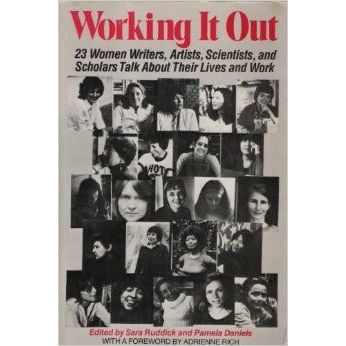
This winter the Berkshire Festival of Women Writers sent out a call for writings on the topic of “the labors of women” for a May reading at the Sandisfield Arts Center. I realized this would give me the opportunity to put into words a long overdue appreciation of the landmark book by Sally Ruddick and Pamela Daniels, Working It Out: 29 Women Writers, Artists, Scientists, and Scholars Talk about Their Lives and Work (Pantheon, 1977).
Below is what I wrote, and read in May, thanks to the Berkshire Festival’s call, and especially thanks to its founder, Jennifer Browdy de Hernandez for conceiving of such a resonant theme (check out Jenny’s excellent blog, Transition Times: Writing to Right the World) and Susie Crofut for bringing the Festival to Sandisfield. The event was terrific, varied, powerful – hope to say more about it when the Festival posts on it.
Working It Out: 29 Women Writers, Artists, Scientists, and Scholars Talk about Their Lives and Work
A poem for Sara (Sally) Ruddick, Feminist philosopher, 1935 – 2011
Twenty-three faces look out from the book’s cover,
young, earnest, marked with intelligence and hope.
Twenty-three women struggling with a simple thing:
To sit down at a desk, stand at an easel,
lean over a laboratory table, and surrender
to their own, original thought –
To the work.
Why was it so hard? Didn’t they have it all –
education, babies, husbands willing to “help” —
And still so hard to close the door, for an hour
or a day, close out the willing husbands,
the babies following with alert, expectant eyes,
the kind, bemused professors that had called them “bright”
but not quite known what to do with them.
And even more, why so hard, once the door closed,
once every obstacle was lifted, to lay claim
to the empty page, blank canvas, forbidden realms
of their teeming minds? Why the deep, inexplicable
paralysis, this “acute pain of worklessness”?
One by one, each of them worked through
that pain in these pages. Read them
and you will see a generation
coming to life in its work, coming to serious,
womanly work embedded in their lives,
work and pleasure not enemies,
but joined.
Sally ends her essay (“A Work of One’s Own”)
saying simply, elegantly, “I turned, as I had learned to do, to other women. We put together this book.”
**
So this was how: twenty-three women facing the pain
with courage and fear, and making the claim together.
Thirty-seven years, Sally, Pamela, Adrienne, Evelyn,
Virginia, Alice, Catherine, Naomi, and the rest,
and we still need your book,
still need to hear those voices, still need
to see you working it out for us, at any age,
and for the work still before us.
—–
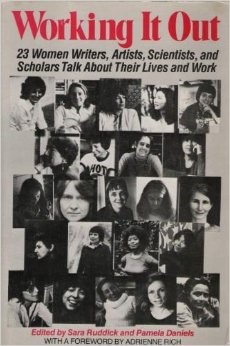
Here is the cover of the book, with all the wonderful faces:
You can find a dog-eared copy of the book on Abe Books for a few dollars, and you can read Sally’s essay, “A Work of One’s Own” at a site established by her family as a living memorial. (Much gratitude to them for the site, absolutely necessary.) Take a look, on that site, for example, at “New School Courses” if you want to see the range, daring, and sheer vitality of one of our era’s most original, generous minds.
Working It Out: 29 Women Writers, Artists, Scientists, and Scholars Talk about Their Lives and Work
A collection of essays edited by Sara Ruddick and Pamela Daniels, published 1977, Pantheon.
Sara Ruddick (Editor), J. Green (Contributor), Alice Walker (Contributor), Tillie Olsen (Contributor), Pamela Daniels (Editor), M. Young (Contributor), Adrienne Rich (Contributor), M. Thornton (Contributor) , C. Sears (Contributor), N.V. Mengel (Contributor), Catherine.R. Stimpson (Contributor), Evelyn Fox. Keller (Contributor), M. Schapiro (Contributor), C. Gilbert (Contributor), M. Stevens (Contributor), D.G. Michener (Contributor), Virginia Valian (Contributor), C.Y. Yu (Contributor), A. Lasoff (Contributor), K.K. Hamod (Contributor), A. Rorty (Contributor), N. Weisstein (Contributor)




 Hilde Weisert