The Red Scare, My Mother, and A Music Critic Who Complied in Advance

Today: The National Endowment for the Humanities in tatters. The Kennedy Center taken over by a Philistine (that may be an insult to Philistines). Libraries closed and books banned. Words expurgated from government websites.

On and on with echoes of Nazis branding real art “degenerate,” Soviet Russia requiring only “Socialist Realism” art, and here, reminders of the effects of the McCarthy era on film and literature. We all know how Hollywood writers and actors were blacklisted, and we’re not surprised to learn of the “complying in advance” of government employees and others in that era who kept their heads down and, like my father when he worked for the State Department, insisted their family not talk politics even with friends.

And when we cancel Washington Post subscriptions because of owner Jeff Bezos’ declared censoring of editorial freedom, we lament the loss of the courageous speaking-truth-to-power Post of Katherine Graham, Woodward and Bernstein, Herblock.

So you may be surprised to know that the chill of the Red Scare did affect the Washington Post at the height of the McCarthy era in, of all things, their music criticism.

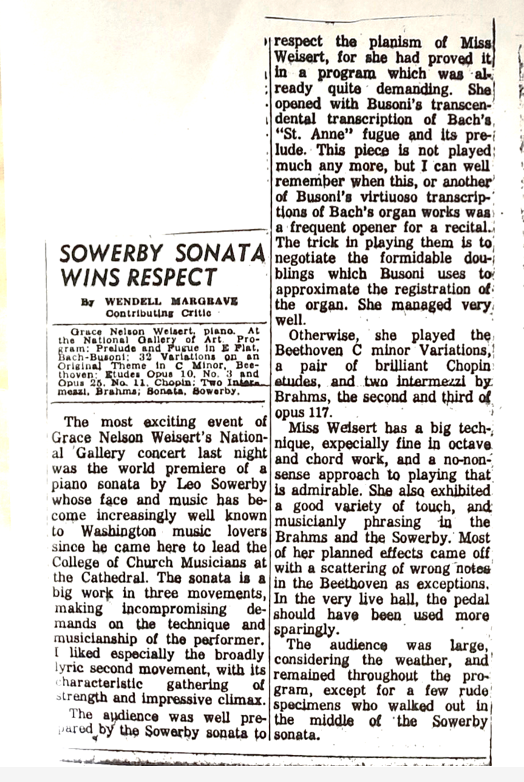
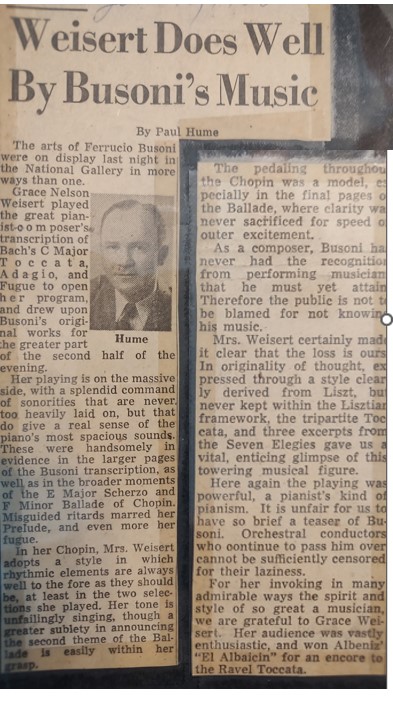
Older music lovers may know the name of the longtime Post music critic, Paul Hume. Others may remember his name as a historical footnote—the critic whose 1950 blistering review of Margaret Truman’s singing inspired her father Harry to threaten Hume with a punch in the nose, or elsewhere. But for me, Hume is the critic who wrote a review of the first recital my mother, Grace Nelson Weisert, played in the National Gallery. A good review, but with an entirely extraneous conclusion that I’ll explain after some background.

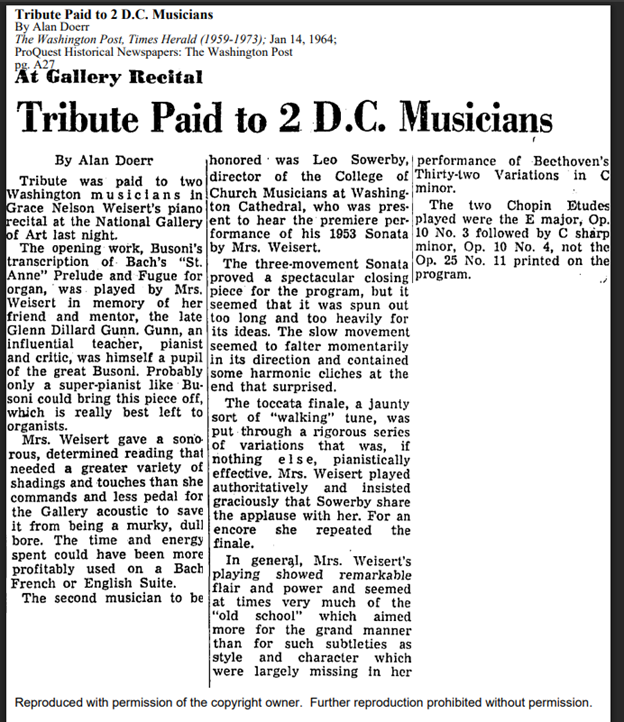
One of the inducements my father had offered my mother for moving, in 1952, from Chicago to Washington (so that he could take a government job) was that she could resume studying with her longtime piano teacher, Glenn Dillard Gunn, and resume her public career after a long hiatus. Gunn, who had studied with Busoni and who had taken my mother on as a student for free when she was 12, had made his own Chicago to Washington move a few years earlier and was both a teacher and music critic for the Washington Times-Herald.

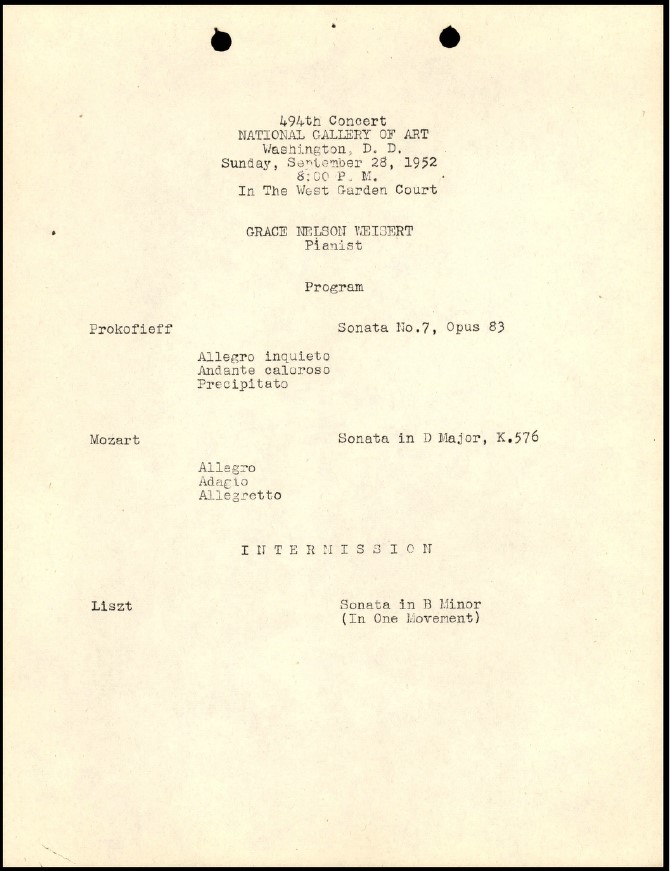
So we moved, and my mother went twice a week to Gunn’s studio on R Street, often with the seven-year-old me, and worked up a program she would perform at the National Gallery. The National Gallery music series in one or the other of the two Garden Courts was highly respected and sure to be attended by the reviewers of all three Washington papers, The Post, The Evening Star, and the Times-Herald.

Gunn wanted her to try something new, to American ears, and fully exercising her considerable gifts, so the program would begin with the most stirring of Prokofiev’s War Sonatas, the Seventh. Dissonant, modern, powerful. No one else was playing it in those days, in that town.

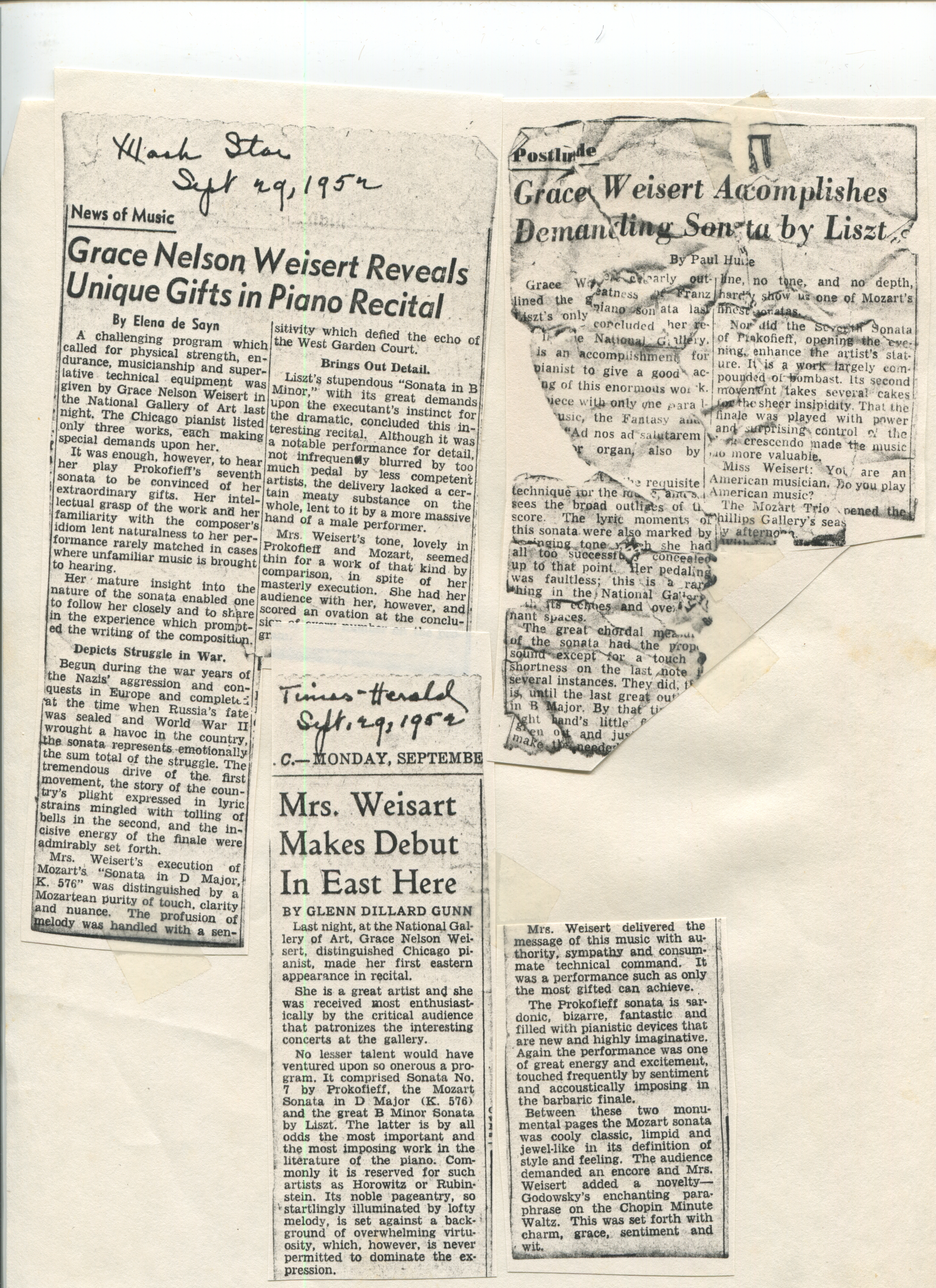
It was quite a program, I realize now, Gunn clearly wanting his star student to make a splash in her Washington debut. After the Prokofiev and the Mozart Sonata in D Major, the program would end with the massive Lizst B Minor Sonata. But her mastery of that challenge (see the reviews below) wasn’t what Hume would leave his readers with.

No, after acknowledging my mother’s skill and talent, though with reservations, Hume left them with something else, and I think it says all you need to know about how, in another era in this country, a powerful out-of-control official—thankfully then, only a senator not a president—could affect even a musical review, twisting even an esteemed music critic into a pretzel of ostentatious and entirely gratuitous patriotism.

It is—ironic isn’t the word, I don’t know what is—odd?—that today what is suspect is far from anything Russian, but the cowardly kowtowing, the compliant and shameful surrender is little different from what we see today from certain powerful law firms, colleges, and other cowardly institutions.

This is how the review — a music review — ended:

“Miss Weisert, you are an American musician. Do you play American music?”

————————————————————————————–

From Wikipedia: Of the War Sonatas, biographer Daniel Jaffé has argued that Prokofiev, “having forced himself to compose a cheerful evocation of the nirvana Stalin wanted everyone to believe he had created” (i.e. in Zdravitsa) then subsequently, in these three sonatas, “expressed his true feelings”.

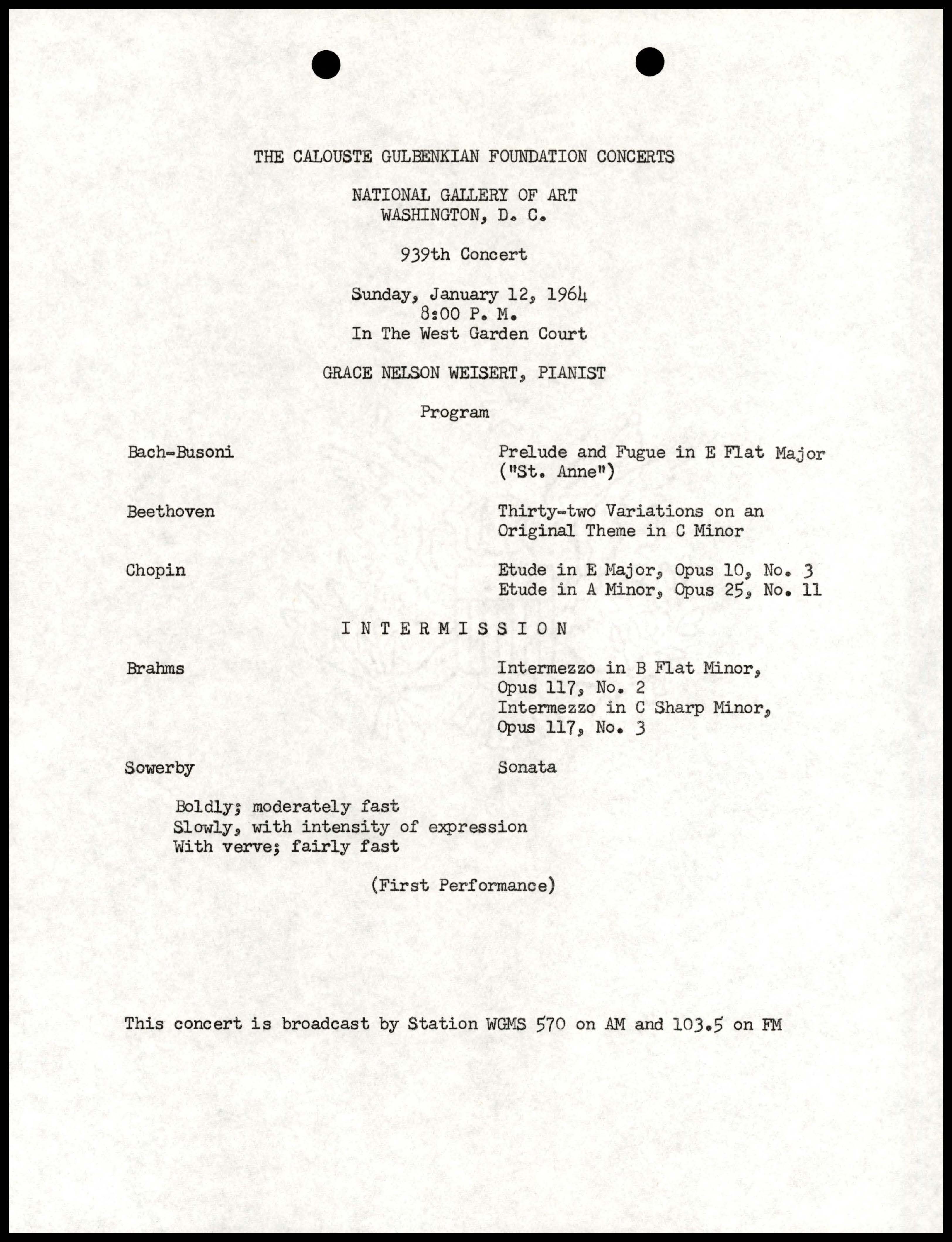
Program and reviews below. Sadly, the Washington Post review (“Grace Weisert Accomplishes Demanding Sonata By Liszt”) had apparently disintegrated before my brother made this copy years ago, but if you look closely you can see his question, the last paragraph before he goes on to write about another concert (the Mozart Trio).

I should add that Hume was in a very different frame of mind six years later when my mother performed at the National Gallery again. Gone was his sour tone and just about everything in that review was positive.

Did he remember the earlier dismissal? Regret it? We’ll never know, but at least here his focus was entirely on the music and the performance.

June 16, 1958, from the Washington Post:

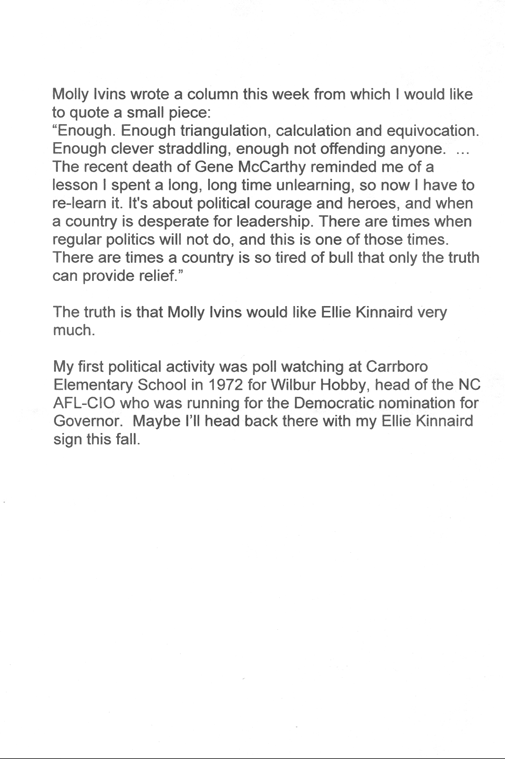
Elizabeth Edwards, 2006: Never More Relevant

January 22, 2006 at a fundraiser for NC Senator Ellie Kinneard

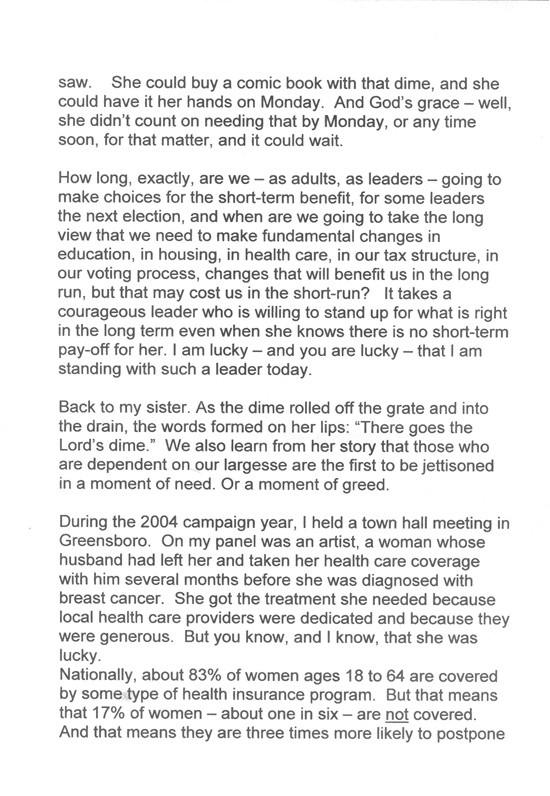
After Elizabeth Edwards spoke at a Chapel Hill 2006 fundraiser (I believe it was January 22) for Senator Kinneard, I asked her if there was somewhere I could get a copy of her talk. She laughed and said the only copy was the one she had with her, which she had written the night before, and then she handed the typed pages to me. I was so surprised I’m not sure I adequately thanked her, but I am really glad she gave me the talk, which is no less important today. The pages she handed me are reproduced below. I see now, in 2006, she even mentions Donald Trump.

Ellie Kinneard in the NC State Sentate and Verla Insko in the NC House were responsible for NC adopting voter-verified paper ballots.

The talk here is the photos I took of the printed speech–you may need to page through.

– Hilde Weisert

How a Good Poem Can Go Bad: Poof!

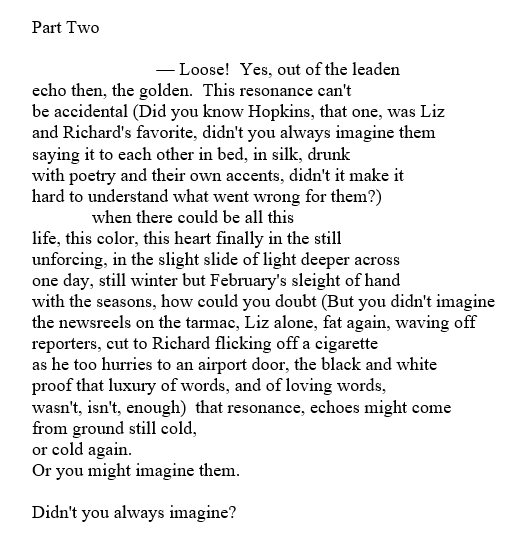
When my friend (and wonderful poet) Joan Barasovska asked me if I could be the standby reader (at her North Caroline Poetry Series April reading at McIntyres bookstore) for the distinguished Michael Hettich, who might not be able to come, I began gathering the five or six poems I thought would read well in the 15 minutes allotted. Three new ones due out this spring, natch. “Imagination Itself,” both for Earth Day and allowing a brief salutation to Sy Safransky, publisher and editor emeritus of The Sun, who had published it years earlier. Since readers were to bring their books, I wanted at least one other from The Scheme of Things.

Of course — for an audience largely made up of poets, I’d read the can’t miss “One Good New Poem.” I hadn’t read it much in recent years but from the time of its first draft in the early 1990s through the publication of The Scheme of Things in 2015, it always went over well, starting with the opening that most writers can relate to. I opened the book and began to say it to myself. Such fun to read aloud!

By now I could imagine I’d have the audience with me–always had. And maybe they’d continue as I described the familiar desolation:

And then the turn, what was once a silly notion that always got a laugh, especially from writers who’d done poetry in the schools classes in elementary schools and knew how children’s imaginations could be so much more vivid than ours:

Wait. What? Buy a gun? Hold people up? Take a 3rd grade class hostage??

I can never read that. Even now, there are probably people of recent generations who could not imagine that that could ever have been “a fanciful notion,” as my husband described it when I described my shock. As a notion, harmless, so outlandish as to be funny. Once.

I don’t think this is the common case of something that was always awful but is only recognized as such by a more evolved sensibility. It is not the world that has changed that makes the evil of “boys will be boys” and “locker room talk” evil. Or the easy assumption of my high-school self that “Gone with the Wind” was a wonderful movie even if it had some problems in how it depicted Black people. Or the slurs in past times for gay people. Those things were always awful.

But honestly, there was a time when to say I’d buy a gun to steal poems from famous poets or hold a 3rd-grade class hostage to steal their dream-images was simply ridiculous, laughable. So unthinkable as to be a fanciful notion.

There was. That time is gone. And of course immeasurably more is lost in that change than the ability for me to ever read this poem aloud again. But what I guess it reminds me is how much has changed, how terribly. Maybe even in 2015 it was too late to say those words — the Columbine shooting was 1999, Sandy Hook was 2012. Maybe I was oblivious that something I had written before Columbine was turning bad. I know I’m not oblivious now, it makes me want to throw up.

A few friends have said maybe I can revise the poem, figure out a different image. Maybe I can. It would be nice to be able to rehabilitate it (is there a Poem Rehab place it could check into?). It would be nice to finish out the desolation of Part 1:

And have a way to get to my Hopkins “Leaden Echo, Golden Echo” conceit, planting one more little flag for the imagination:

It might be nice. But there are things, thanks to how the unthinkable has been made almost ordinary, that even the imagination cannot do.

The Language of “Black Lives Matter”

Matter dictionary entry
I am struck by the simple beauty and truth of the sentence, “Black lives matter.” I am also struck by the nonsense of the too-common rejoinder “All lives matter” as any kind of answer. That “reply” is a failure in many ways—empathy, political and historical knowledge, humanity, morality – but also simply a failure of language.

“Black lives matter” is a modest, and yet a radical, claim. Modest because “matter” in such a statement never means “Only (this) matters.” Radical because having to say that something important “matters” implies a forgotten, or a never recognized, “too.” Taking nothing away from anyone, it simply claims inclusion for what had, demonstrably, not been thought to matter. “Matter” in this context always implies “too.” Not understanding that means not understanding what “matter” means. Black lives matter, too. Hey, people: Black lives matter too!

The thing is, if you are the one whose life has the presumption of mattering, no assertion is necessary. You don’t even need to think about it, it just is. Before the #BlackLivesMatter movement, who ever heard anyone saying “All lives matter”? Besides the obvious hypocrisy of that statement, which has been pointed out elsewhere, as a response to “Black lives matter” it’s dismissive, it’s ignorant, and it’s linguistically inane.

A relationship is not good, or whole, if only one person’s needs matter, worse if that person is oblivious to the fact. It is not good for either party. A country and a society is not good, or whole, if only those who have always presumed they mattered – without giving it a thought – matter.

Another word in the sentence that is perfectly chosen and must be heard is “lives.” Not “people.” This is not a claim about Black people. It is a claim about Black lives. Because, as we have seen in the last weeks, and, if we care to look, the last years, decades, and centuries, it is Black lives that are at stake.

I hasten to say that I am not trying to explain the movement itself, something for which I am neither qualified nor needed; founders Patrisse Khan-Cullors, Alicia Garza, and Opal Tometi (you can read their impressive biographies here) and others in the movement have done that and continue doing it every day. I am simply awed by their brilliance in creating the simple, powerful, world-changing statement “Black lives matter.” As a poet, I hear it as poetry, but poetry that has and will continue to make something happen. Starting with our hearing what it really means. And answering without being fools.

Lastly, for anyone still thinking there is anything narrow about “Black lives matter,” check out what the movement is doing in 2020, here. This movement is good for all of us. Odd, isn’t it, that “Black lives matter” turns out to be much more genuinely inclusive than the insincere and facile “All lives matter”?

From the Black Lives Matter website: BLM’s #WhatMatters2020 will focus on issues concerning racial injustice, police brutality, criminal justice reform, Black immigration, economic injustice, LGBTQIA+ and human rights, environmental injustice, access to healthcare, access to quality education, and voting rights and suppression.
This initiative will inspire and motivate people to ask themselves and their candidates, are you really addressing What Matters in 2020?

Ursula Le Guin, Writing about What Matters

This piece is for the people who say, Oh, yes, Ursula K. Le Guin – I really don’t read sci fi. Or, Ursula K. Le Guin, I just love her sci fi novels. Who in either case may not know that this was as fine and thoughtful a poet as any in our time, and essayist; literary critic and public intellectual; and gifted translator. If you’re a poet, a novelist, an essayist; if you’re a reader, and you do not know this side of Le Guin — what a wealth awaits you. Links at the end for the books mentioned are of course not to Amazon, but to IndieBound or Abe Books. For in print books, check with your local independent bookstore.

When we met, I had only two of her books on my shelf, specifically on the feminist book shelf: Dancing at the Edge of the World: Thoughts on Words, Women, Places (1989), that was browning around the edges, and the more recent The Wave in the Mind: Talks and Essays on the Writer, the Reader, and the Imagination (2004). I knew her name, of course, but I had to pull the books out to remember my own connection to essays I had savored—

“Is Gender Necessary? Redux”
“Reciprocity of Prose and Poetry”
“A Left-Handed Commencement Address” (reminding me she had written a novel called The Left Hand of Darkness and now saddening me I never thought to ask, or notice, if we shared left-handedness? or perhaps, absurdly, was that what she saw in me?)
“Being Taken for Granite”
“My Libraries”
“Off the Page: Loud Cows: A Talk and a Poem about Reading Aloud”
“The Writer On, and At, Her Work”

— To remember the vitality, the little jolt of pleasure and heightened awareness at this original, familiar, intimate voice. These were talks at college commencements, library openings, reviews, occasional pieces.

“Introducing Myself” is a performance piece that begins

I am a man. Now you may think I’ve made some kind of silly mistake about gender, or maybe that I’m trying to fool you, because my first name ends in a, and I own three bras, and I’ve been pregnant five times, and other things like that that you might have noticed, little details. But details don’t matter. If we have anything to learn from politicians, it’s that details don’t matter. I am a man, and I want you to believe and accept this fact, just as I did for many years.

As I read that now, the first essay in The Wave in the Mind, I remember sitting up a little straighter back in 2005 or 2006 as I thought about my mother and the pride she took in thinking like a man, playing the piano like a man, scoring on an IQ test better than any man in our family, joining the men after dinner to talk about real things. That toxic pride that Ursula names and – I’m reaching for a verb, there might have to be a new one – Ursula-izes – in five pages, ending with

Sometimes I think I might just as well exercise my option, stop short in front of the five-barred gate, and let the nazi fall off onto his head. If I’m no good at pretending to be a man and no good at being young, I might just as we ll start pretending that I am an old woman. I am not sure that anybody has invented old women yet; but it might be worth trying.

Ah, but what inventions were yet to come!

Lest you think the essays are all of feminist interest only, there are as many bracing, revelatory pieces about writing and poetry, about the imagination and about our society.

Damn, I am only just now reading “’Forsaking Kingdoms’: Five Poets” (1984) to find

May Sarton is a mere septuagenarian, but count her title list with awe. This is a writer, this is what writers do: fourteen volumes of poetry, seventeen of fiction, two books for kids, and seven books of essays. (Ah, Ursula recognizing kin. I wonder if Sarton was anywhere near Le Guin in the other realm, the one I entered, correspondence and poems and thoughts exchanged with writers whose names I am only beginning to learn about as we each step out of our cherished private, closely held, miraculous friendships to write a short post, an essay, a tribute.)

Continuing on Sarton:

The newest of the lot, Letters from Maine, is mostly easy-going…one may be soothed by the conventionality…but look out. Sudden authority rings like sword steel.

I began re-reading Letters from Maine last spring with a plan to write a “Throwback Thursday” review at the request of Glass: A Journal of Poetry. Always meant to ask Ursula what she thought of Sarton. And Levertov – for some reason I was a little wary of asking her about Levertov, afraid she might not find as much to like as I had. But I needn’t have hesitated — here is what I find in that 1984 essay:

Denise Levertov’s mastery—more than mastery, because she is one of the originators—of contemporary poetic form, informed by a fierce, generous intelligence, can be frightening. This is the charged, overloaded poetry of the age, demanding more of the reader than most of us are willing to give, so we don’t read poetry, we read a thriller or something, and oh, what dolts we are, what wasters of our own brief time—to miss this tenderness, this kind companion in hard times, not trying to sell us anything or scare us or fool us, but going along with us.

And besides, if we did disagree – she disliked the poetry of some of the usual gods we lesser mortals genuflected for, like Seamus Heaney, and even Emily Dickinson! – that would have been fine, too. Actually, she would have been curious about what I found to like, and I would have wished I had more to offer than received wisdom and the line about digging with a pen.

The Wave in the Mind takes its title from a letter by Virginia Woolf (writing to Vita Sackville-West, 16 March 1926) that Le Guin quotes at the beginning of the book and that I would like to commit to memory:

As for the mot juste, you are quite wrong. Style is a very simple matter: it is all rhythm. Once you get that, you can’t use the wrong words. But on the other hand here am I sitting half the morning, crammed with ideas, and visions, and so on, and can’t dislodge them, for lack of the right rhythm. Now this is very profound, what rhythm is, and goes far deeper than words. A sight, an emotion, creates this wave in the mind, long before it makes words to fit it; and in writing (such is my present belief) one has to recapture this, and set this working (which has nothing apparently to do with words) and then, as it breaks and tumbles in the mind, it makes words to fit it. But no doubt I shall think very differently next year.

— Virginia Woolf, writing to Vita Sackville-West, 16 March 1926

Another topic I wish I’d raised with her. When I was planning a workshop on walking and poetry, where indeed part of the point is the rhythm that walking provides, we did discuss the effect of/interaction of walking and poetry, but not that wave in the mind, which I am feeling a bit right now. Rhythm, with a little vertigo.

From 2010 to September 25, 2017, Ursula wrote a blog on topics ranging from the political to the literary, the universal to the personal (the personal often in the person of the cat Pard and his annals (with wonderful pictures). Many of these pieces have been collected in a volume published in December, 2017 and titled for her second post, in 2010, No Time to Spare:Thinking About What Matters (collected and introduced by the celebrated fiction writer Karen Joy Fowler). The title piece was occasioned by a question on the Harvard 60th anniversary survey, “What do you do with your spare time?” You can imagine what Ursula thought of that. (In the introduction to “The Hope of Rabbits: A Journal of a Writer’s Week” she writes “I attended a women’s college that was embedded like a seed pearl in a gigantic male oyster.”)

Online, the blog is in separate pages by year, from http://www.ursulakleguin.com/Blog2010.html (the beginning) to http://www.ursulakleguin.com/Blog2017.html#New (the last). Pieces included in the book are deleted, a link to the book added, but there is still much here to savor that apparently did not get included, including much about Pard (with the lovely pictures).

2019 note: The blog is still accessible but at an archive site– http://ursulakleguinarchive.com/Blog-Index.html

Oh wait – I should have known that in the many and multifarious ways of UKL (or her digital accomplices), the posts with the “annals of Pard” tag would be collected in one place, here http://bookviewcafe.com/blog/tag/annals-of-pard/ . Full of delight and uncanny insight into the mind of a cat, these are in the same league as Don Marquis or E.B. White.

Many of these pieces are laugh-out-loud funny – for example, “#44. People I don’t want to hear any more about.”

But the blog pieces are also the reflections of one of our great public intellectuals wrestling with the major events of our time – the place of religion in our lives (“An Attempt to Think as a Free Thinker”), the occupation of the Malheur Refuge headquarters (“#110. Thirty-Five Days”), a piece about the 2016 election (“119. The Election, Lao Tzu, a Cup of Water” that concludes with this:

I know what I want. I want to live with courage, with compassion, in patience, in peace.

The way of the warrior fully admits only the first of these, and wholly denies the last.

The way of the water admits them all.

     The flow of a river is a model for me of courage that can keep me going — carry me through the bad places, the bad times. A courage that is compliant by choice and uses force only when compelled, always seeking the best way, the easiest way, but if not finding any easy way still, always, going on.

     The cup of water that gives itself to thirst is a model for me of the compassion that gives itself freely. Water is generous, tolerant, does not hold itself apart, lets itself be used by any need. Water goes, as Lao Tzu says, to the lowest places, vile places, accepts contamination, accepts foulness, and yet comes through again always as itself, pure, cleansed, and cleansing.

     Running water and the sea are models for me of patience: their easy, steady obedience to necessity, to the pull of the moon in the sea-tides and the pull of the earth always downward; the immense power of that obedience.

     I have no model for peace, only glimpses of it, metaphors for it, similes to what I cannot fully grasp and hold. Among them: a bowl of clear water. A boat drifting on a slow river. A lake among hills. The vast depths of the sea. A drop of water at the tip of a leaf. The sound of rain. The sound of a fountain. The bright dance of the water-spray from a garden hose, the scent of wet earth.

This is followed by a poem, “Meditation”. I am sure I am not alone in finding great comfort in this piece, and in Lao Tzu, in such times as ours.

Matter” is a word that matters to Le Guin, I notice as I look at the two most recent essay collections, No Time To Spare and Words Are My Matter: Writings about Life and Books 2000-2016”.

ursulatwobooks

The latter I was not aware of until I saw it in a display on the front counter at Flyleaf, my local Chapel Hill independent bookstore, shortly after Ursula died. Although she would often email me a poem she was working on (amazingly, to ask my opinion!), she almost never announced her new publications. So I assumed the book was a combination of some earlier essays from The Wave in the Mind plus some written since. It turns out there is one repeat (“The Operating Instructions”), but mostly these are all previously uncollected, just that mere fraction of what Ursula Le Guin was doing over the last decade and a half. The table of contents shows the range, and if it does not tempt you to go to your local bookstore and get the book, then – well, I don’t know. Here’s the list for the first section:
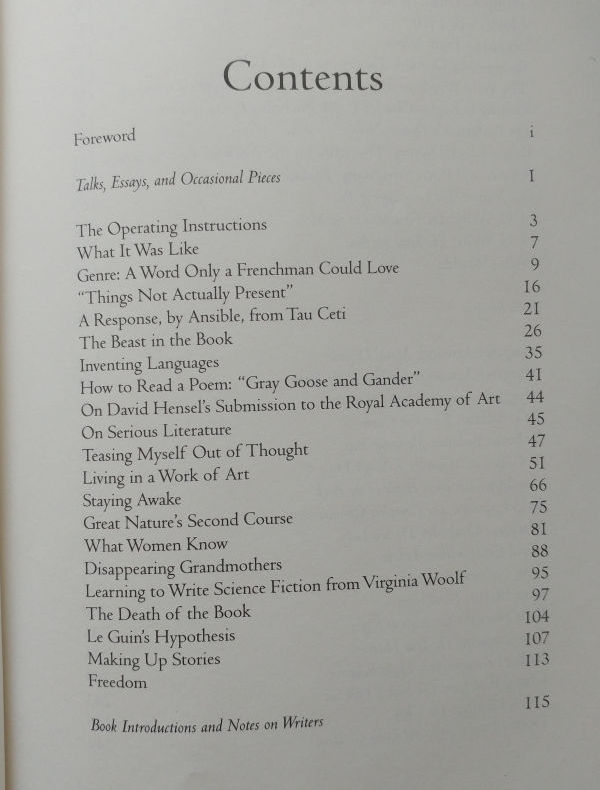
wordsaremymattertoc1-2

The book reviews include pieces on Margaret Atwood, Geraldine Brooks, Italo Calvino, Margaret Drabble, Barbara Kingsolver, Doris Lessing, and Donna Leon (Donna Leon! oh my, oh damn, how did I not know she read my favorite mystery writer?). And at the end, a gift, for anyone who has gone to a writer’s retreat, “The Hope of Rabbits: A Journal of a Writer’s Week,” about her time at Hedgebrook. In the introduction to that diary there’s what I believe will be all that needs to be said — and without ranting — about the virtues of handwriting, in part:

“I think about the humane pace of longhand, and how one is constantly looking away from the notebook at things around it, near or far, changing position as one sits, doodling in the margin while working out a transition, half-consciously noticing the slant of the sunlight, the advance of shadows, the color of the sky; fully absorbed in the work, and yet open to the surrounding world…”

A silver lining of my not keeping up well with the recent writings is that I still have so much to read that’s new. Though, as I dip back into the books that are dog-eared, I realize as well that almost any of these pieces are as fresh and readable today as they were the first time.

What reading the essays, reviews, and talks allows, that I don’t believe the fiction does, is hearing the human voice of the person Ursula Kroeber Le Guin. To read these works is to feel one is in her presence.  Nothing on earth like it.

***

Ursula Le Guin also had a significant career as a translator, notably of Lao Tzu’s Tao Te Ching, but also in The Twins, the Dream/Las Gemalas, El Sueno, a volume of mutual translation with the Argentine poet Diana Bellessi (each translates the other), and in 2003, The Selected Poems of Gabriela Mistral, which I’ll attempt to do justice to in another blog piece. 

Books discussed: Essays, talks, reviews

The Wave in the Mind: Talks and Essays on the Writer, the Reader, and the Imagination (from IndieBound, new)

Dancing at the Edge of the World: Thoughts on Words, Women, Places (from AbeBooks, used)

No Time to Spare:Thinking About What Matters (from IndieBound, new)

Words Are My Matter: Writings about Life and Books 2000-2016 (from IndieBound, new)


“Finom”: A word for winter soup

ilonasdeskI’ve noticed how often poets I know will post something about food on their social media sites — delicious food, often with pictures. In the summer, there are usually tomatoes and other fruits of the garden; in the winter, it’s often stews and soups.

On a cold day in Chapel Hill — and colder up north where many of my friends are — I thought I’d share two poems (from my 2015 collection, The Scheme of Things) where soup is the subject, or an important part of the subject, as it has been an important part of my life, with meaning and sustenance far beyond the calories. Both poems are, of course, also about family.

Finom

“Finom” – That’s what you say in Hungary
about delicious soup. In my bowl,
the soup gleams Hapsburg yellow
flecked with rusty paprikash,
buttery with chicken and spaetzle.

I look up from my bowl and say it –
“fee-nome” – and Agnes the cook beams,
and my stepmother Ilona beams,
as if I had done something wonderful also.
The small apartment is all aroma now,

happy for us to breathe it. Am I drunk?
On the walls Ilona’s pictures float:
a great stag slain beneath a steed from whom
the steely count faces us, swathed in bear and stoat—
Ilona’s father no more dead than mine who stands

in mid-century American shirtsleeves next to a red Mustang
and faithful boxer Flick at a roadside stop
in the hills above Beirut, the city
where he and Ilona met; or than I, raising a glass
on the square in St-Jean-de-Luz, the sheen

on the warm Bordeaux catching like a camera obscura
my husband and the sea beyond in crystal miniature.
Now, this January day in Budapest, I fill myself
with what will warm me in my own allotted winters—
these fathers, sisters, husbands, brothers,

dogs, arrayed on walls and tables, all here
in one spell of soup for which there is a word
“finom”, delicious in its bright upward kiss,
its Magyar gift. Here, a strange adjective
becomes an intimate noun,
a necessary name.

Three Stars

In Paris together after twenty years, we walk half the map by one,
Porte Maillot down a zig-and-zag diagonal to our old Café Verdun.
We walk, and the Plan’s red-and-black lines block-by-block unflatten
into real-life streets, the smell of bread, and children wearing hats;
ancient echoing courtyards and the earthy exhalations of the Metro stations.
We walk alike, with ease, but talk like strangers stumbling through translation.
Still, I’m restored, quenched by northern light like water,
alive and on foot in Paris, remembering, zig by zag, what it was to be your daughter

long ago.  When you brought us here, your little woolen family in the gloom,
the grit of war on walls, Europe was as strange as Asia, and yet made for us.
You weren’t much of a father, Father, but I eat Verdun’s carrot-leek potage
and the gritty long-lost warmth salves everything.  How we made this home,
and then could leave, and how you shook your fist (You’d paid for us!)
is beyond me, mon père. Quand-même ! I give your page three stars: Vaut le voyage.

Both poems are from The Scheme of ThingsDavid Robert Books, 2015.

I don’t know the recipe that Agnes used for the Hungarian soup, but here’s a poem by Daniel Hyikos about the making of a similar soup that might well have merited a “finom,” even if the author does wind up eating it alone: Potato Soup”.  If you know of other winter-soup poems, please post a link in the comments!


Making Up for April’s Tweets: Beyond the #FavoriteLine

After an April chock-full of every poet and poetry reader’s tweeted first and favorite lines, I’d like to share some lines that didn’t fit into 140 characters, or didn’t make sense extracted from their surroundings.

Although there are plenty of terrific “stand-alone” lines, when I set myself the goal of sharing a #FavoriteLine or #1stLine throughout the month, I realized that most of my favorites are favorites for what comes before or after, inextricable from the poems they live in. In fact, on the last day of the month, I broke down and cheated, slipping in a virgule so that I could share the magical ending of James Wright’s “A Blessing”:

twitterapril

The poem is what its title says – a blessing. Read it here.

Some other lines that kept coming to me in April – and have been part of my mental landscape in many cases since I first started reading poetry — that would have made little sense by themselves:

“I got so I could take his name” (Emily Dickinson) (link; ignore the reading)

“Bow-wow, bow-wow, bow-wow” (Mark Doty, “Golden Retrievals”) (link)

“I, having loved ever since I was a child, a few things” (Edna St. Vincent Millay, “Modern Declaration”) (link)

“And we let him in” (Thomas Hardy, “Snow in the Suburbs”) (link)

“No doubt left. Enough deceiving” (James Agee, “No doubt left. Enough deceiving” – included at the end of this post)

“Ah, Grief, I should not treat you/like a homeless dog” (Denise Levertov, “Talking to Grief”) (link)

“Love is not all, it is not meat nor drink” (actually, maybe that does work by itself, especially since so many poetry lovers will immediately hear the next lines –

Nor slumber, nor a roof against the rain, nor yet
A floating spar to men that sink, and rise, and sink and rise again… (link)

The favorite-line doesn’t favor enjambment, so I couldn’t tweet such lines as those one can’t hear without their wrap-around completion:

“Ah love, let us be true/to one another” (Matthew Arnold, “Dover Beach”) (link)

“Is that dance slowing in the mind of man/that made him think the universe could hum” (Theodore Roethke, “The Dance” in “Four for Sir John Davies” – included at the end of this post)

“…Whatever/what is is is what/I want.” (Galway Kinnell)

The whole poem is not much longer, so I’ll include it here – memorizable the first time you read it!

“Prayer,” by Galway Kinnell, from A New Selected Poems (Mariner Books).

Whatever happens. Whatever
what is is is what
I want. Only that. But that.

Finally, when I posted my chosen first or favorite lines for #NationalPoetryMonth, I felt a little sheepish about space constraints preventing me from including a link or the text of the whole poem. So here are some of those lines with links to their poems.

#1stLine: “He thought he kept the universe alone”—Robert Frost “The Most of It” (included at the end of this post)

#FavoriteLine: “Till the gossamer thread you fling catch somewhere, O my soul.” –Walt Whitman “A Noiseless Patient Spider” (link)

#FavoriteLine: “Prove that I lie”—WB Yeats “Her Anxiety” (link) (ignore the reading)

#FavoriteLine: “To the eyes of a man of imagination, nature is imagination itself”—William Blake, Letter

The context is this paragraph, brilliantly cited by W.S. Merwin in his 2010 Poet Laureate Inaugural Reading, “The Imagination of Man’:

“The tree which moves some to tears of joy is in the eyes of others only a green thing that stands in the way”. Some see nature all ridicule and deformity… and some scarce see nature at all. But to the eyes of a man of imagination, nature is imagination itself.”

#FavoriteLine:“The certainty of others—the life, love, sight, hearing of others.”—Walt Whitman “Crossing Brooklyn Ferry” (link)

#FavoriteLine:“I can remember when he was a pup”—Robert Frost“The Span of Life”
(link) (ignore the reading)

#FavoriteLine: “All that I saw was China, China, China.”—Richard Wilbur “Digging for China” (link to the Writers Almanac with text and reading)

Poems for which there is no good online link (I recommend the books!):

No doubt left. Enough deceiving.

James Agee (from Promise Me Voyage – that title is a quote from Hart Crane)

No doubt left. Enough deceiving.
Now I know you do not love.
Now you know I do not love.
Now we know we do not love.
No more doubt. No more
deceiving.
Yet there is pity in us for each other
And better times are almost fresh as true.
The dog returns. And the man to his mother.
And tides. And you to me. And I to you.
And we are cowardly kind the cruellest way,
Feeling the cliff unmorsel from our heels
And knowing balance gone, we smile, and stay
A little, whirling our arms like desperate wheels.

Four for Sir John Davies:

The Dance

Theodore Roethke (from Words for the Wind)

Is that dance slowing in the mind of man
That made him think the universe could hum?
That great wheel turns its axle when it can;
I need a place to sing, and dancing-room,
And I have made a promise to my ears
I’ll sing and whistle romping with the bears.

For they are all my friends: I saw one slide
Down a steep hillside on a cake of ice,—
Or was that in a book? I think with pride:
A caged bear rarely does the same thing twice
In the same way: O watch his body sway!—
This animal remembering to be gay.

I tried to fling my shadow at the moon,
The while my blood leaped with a wordless song.
Though dancing needs a master, I had none
To teach my toes to listen to my tongue.
But what I learned there, dancing all alone,
Was not the joyless motion of a stone.

I take this cadence from a man named Yeats;
I take it, and I give it back again:
For other tunes and other wanton beats
Have tossed my heart and fiddled through my brain.
Yes, I was dancing-mad, and how
That came to be the bears and Yeats would know.

The Most of It

Robert Frost (from any good Frost collection)

He thought he kept the universe alone;
For all the voice in answer he could wake
Was but the mocking echo of his own
From some tree–hidden cliff across the lake.
Some morning from the boulder–broken beach
He would cry out on life, that what it wants
Is not its own love back in copy speech,
But counter–love, original response.
And nothing ever came of what he cried
Unless it was the embodiment that crashed
In the cliff’s talus on the other side,
And then in the far distant water splashed,
But after a time allowed for it to swim,
Instead of proving human when it neared
And someone else additional to him,
As a great buck it powerfully appeared,
Pushing the crumpled water up ahead,
And landed pouring like a waterfall,
And stumbled through the rocks with horny tread,
And forced the underbrush—and that was all.

The Debt of It: To Six Poets and a Moose

moose
Not the actual moose I saw (I had no camera) but very similar

As poet Leslie McGrath wrote in selecting my poem “The Pity of It” for the Tiferet Journal 2016 Poetry Award, the poem is “a paean to Robert Frost’s ‘The Most of It.’” But my debt is to more than Frost, and describing that debt is a way of explaining how my own small poetic powers are sometimes transcended through immersion in reading and seeing through the eyes of other writers. For me, this can be a magical process, almost as magical as the human-wild encounters in “The Most of It” and the other poems that echo in mine. I suspect I’m not the only writer who experiences this.

Several years before I had my own encounter with a moose, I was drawn to Frost’s poem “The Most of It” by what poet Molly Peacock wrote in her introduction to the “Passages” section of the Animal Companions, Animal Doctors, Animal People anthology:

“It’s not our own images that help us recognize ourselves, but our visions of other species. As Robert Frost says in my favorite poem about a person’s essential being, “The Most of It,” the spirit that truly recognizes us arrives in animal form. “He thought he kept the universe alone,” Frost begins, yearning for a response to his loneliness, and finds that this response, “instead of proving human” is “a great buck” swimming in a lake, “pushing the crumpled water up ahead” as it emerges on shore and lands “pouring like a waterfall.” He meets himself in the buck.”

Who could resist looking up such a poem? I found it on page 451 of my Complete Poems of Robert Frost (New York, New York: Holt, Rinehart and Winston, 1964) – previously glanced at and, I am ashamed to say, passed over in favor of something a little more relatable, say, “The Oven Bird.” But if it was Molly Peacock’s favorite poem “about a person’s essential being” (one of my favorite subjects, or so I like to think), it was clearly worth an hour or so of quiet reading and re-reading. So I sat in my reading chair and came to see with my own eyes (mind’s eyes) what Frost’s “he” saw:

…the embodiment that crashed
In the cliff’s talus on the other side,
And then in the far distant water splashed,
But after a time allowed for it to swim,
Instead of proving human when it neared
And someone else additional to him,
As a great buck it powerfully appeared,
Pushing the crumpled water up ahead,
And landed pouring like a waterfall,
And stumbled through the rocks with horny tread,
And forced the underbrush—and that was all.

One sentence! One breath, simultaneously held and taken away with the emerging apparition, a form imagined to be human turning into something not at all human, looming, landing – I can almost feel the spray of the waterfall on my face, my shoulders — then stumbling (but with horny tread, a majestic stumble) and disappearing into – no, this creature does not just fade away — forcing the underbrush.

And that was all?! I began to understand what Molly wrote. All? More than enough. But even as I sat with the shadow of that apparition, I knew there were still mysteries in the poem that were beyond me, but perhaps not beyond Randall Jarrell. Jarrell is the critic who in the early 1950’s rescued Frost from his mid-century, cracker-barrel Yankee geniality (“a sort of Olympian Will Rogers out of Tanglewood Tales…neglected or depreciated by intellectuals”) and brought him into the canon as a great poet whose best poems “are extraordinarily subtle and strange, poems which express an attitude that, at its most extreme, makes pessimism seem a hopeful evasion” (“The Other Frost” in Poetry and the Age).

Also in Poetry and the Age is Jarrell’s longer essay on Frost, “To the Laodiceans,” where I found what I was looking for:

“Another impressive unfamiliar poem is “The Most of It,” a poem which indicates as well as any I can think of Frost’s stubborn truthfulness, his willingness to admit both the falseness in the cliché and the falseness in the contradiction of that cliché; if the universe never gives us either a black or white answer, but only a black-and-white one that is somehow not an answer at all, still its inhuman not-answer exceeds any answer that we human beings could have thought of or wished for.”

Its inhuman not-answer exceeds any answer that we humans could have thought of or wished for. Thank you, Randall. Although he wrote in a very different time, long before today’s commonplace acceptance of our kinship and even shared personhood with non-human animals (long before even the need to qualify “animals” or “person”), I think he’s saying something very like what Peacock says. We stand before what is beyond any answer we might have thought of or wished for, but we stand in awe and recognition that makes us more than we were.

I live part-time in western Massachusetts, where over the last twenty years or so wild animals have been returning – wolves, foxes, coyotes, black bears, wildcats, and, depending on who you believe, mountain lions. Thrilling if sometimes unsettling, as you see something low and lithe amble up your driveway at twilight, or a dark crouched figure lope past your bedroom window at  teatime.

And then one day I saw, on my own road, my own moose, close enough for – well, for what my poem tells. What was she doing here, south of where she belongs – Canada, Maine, New Hampshire?

Looking for food. And what is she prey to? Ticks – not only here, but also up north, now that it’s warm enough that ticks thrive where it was once far too cold. In epidemic proportions.

I won’t recap the National Geographic and other stories about the devastating effect of ticks on moose (here’s one http://channel.nationalgeographic.com/wild/videos/ticks-can-kill-moose/), but that knowledge was with me as I stood, and the moose stood, on our road, each a witness (or so it felt to me, perhaps not to her) to the other alien being.

Later, wanting to say what I saw, I began to make my own way back through Frost’s poem, as McGrath says, to write what came to be “my paean,” but I needed more than Frost, I needed the courage and the sight and the awe felt by gutsy New England women as well as Frost’s “he.”  Women and their moose poems, their joyful encounters with the strange and magical other. I knew I’d read it over the years, in Bishop, Sexton, Kumin.

Most famously in Elizabeth Bishop’s “The Moose” and its “strange sensation of joy,” a long poem ending with this encounter:

—Suddenly the bus driver
stops with a jolt,
turns off his lights.
A moose has come out of
the impenetrable wood
and stands there, looms, rather,
in the middle of the road.
It approaches; it sniffs at
the bus’s hot hood.

Towering, antlerless,
high as a church,
homely as a house
(or, safe as houses).
A man’s voice assures us
“Perfectly harmless….”

Some of the passengers
exclaim in whispers,
childishly, softly,
“Sure are big creatures.”
“It’s awful plain.”
“Look! It’s a she!”

Taking her time,
she looks the bus over,
grand, otherworldly.
Why, why do we feel
(we all feel) this sweet
sensation of joy?

“Curious creatures,”
says our quiet driver,
rolling his r’s.
“Look at that, would you.”
Then he shifts gears.
For a moment longer,

by craning backward,
the moose can be seen
on the moonlit macadam;
then there’s a dim
smell of moose, an acrid
smell of gasoline.

Or “hopelessly alive,” in Anne Sexton’s section “II. Bestiary USA” in 45 Mercy Street

MOOSE

American Archangel you are going –
your body as big as a moving van –
the houses, the highways are turning you in.
Before my house was, you stood there grazing
and before that my grandfather’s home with you
on the wall. Antlers for hat racks
and I felt the rest of your body somewhere outside
the wall merely asking for an invitation.
You stand alone now in a field in Maine,
hopelessly alive,
your antlers like seaweed,
your face like a wolf’s death mask,
your mouth a virgin, your nose a nipple,
your legs muscled up like knitting balls,
your neck mournful as an axe,
and I would like to ask you into my garden
so that I might pack you quickly in salt
and keep your body proud past your mystery
and mine.

And in Maxine Kumin’s “My Elusive Guest”:

Thoreau loved the grayness of them, homespun
with leafy horns like lichen made of bone.
God’s own horses, poor timid creatures, he said
in 1846 in THE MAINE WOODS
and then went on to wonder why they stood
so high at the shoulders, why so long a head,
no tail to speak of. How like the camelopard,
he said, rolling the archaic word
on hit tongue: high before and low behind
and stayed admiring them, upwind.

A hundred years later, the widow Bliss
whose rockbound farm I now inhabit
broomed a moose out of her kitchen garden
thinking it the neighbor’s brown cow
marauding among her vegetables at dawn
then looked up to behold those rabbit
ears, that wet nearsighted eye
that ferny rack of gray on a still-gray sky
and none since. Spring mornings at first light
sometimes through fog some heavy weight
shufts and wavers against the line of trees
and wanting it in my blood, like a spray
of musk, I beckon the elusive guest,
willing it close. My wild thing, my moose.

With all of these poets and pages around me, and the dirt road of my encounter 50 feet or so below the window in my writing room, I stitched my way into and through my own poem, and the experience it reached back for, using Frost’s poem, as Leslie McGrath so aptly noted, for its formal constraint (as Ursula Le Guin says in “Form, Free Verse, Free Form: Some Thoughts,” “My most revealing discovery was that a form can give me a poem.”), but seeing too glimpses of what Bishop, Sexton, Kumin, and through Kumin, Thoreau, saw. A kind of stealing I hope is so obvious as to make its debt, and love, clear – but if it wasn’t before, let it be, now. And of course, the original debt, to what Molly Peacock and her colleague, Randall Jarrell, recognized. My moose? Hardly. My poem?

Here’s “The Most of It” in its entirety.

ROBERT FROST

The Most of It

He thought he kept the universe alone;
For all the voice in answer he could wake
Was but the mocking echo of his own
From some tree-hidden creek across the lake.
Some morning from the boulder-broken beach
He would cry out on life, that what it wants
Is not its own love back in copy speech,
But counter-love, original response.
And nothing ever came of what he cried
Unless it was the embodiment that crashed
In the cliff’s talus on the other side,
And then in the far-distant water splashed,
But after a time allowed for it to swim,
Instead of proving human when it neared
And someone else additional to him,
As a great buck it powerfully appeared,
Pushing the crumpled water up ahead,
And landed pouring like a waterfall,
And stumbled through the rocks with horny tread,
And forced the underbrush – and that was all.

From his book A Witness Tree, 1942

——————————————

My poem “The Pity of It” is in the 2017 Tiferet Winter issue and reproduced here.

From Judge Leslie McGrath: “Hilde Weisert’s “The Pity of It” is both a paean to Frost’s “The Most of It” and a beautifully restrained portrait of an encounter with another moose as the earth sits on the edge of environmental disaster. The poem’s formal constraints and the speaker’s humility make this poem not just memorable, but haunting.”

About Tiferet Journal: Tiferet is a non-sectarian, non-dogmatic publication and community at the nexus of literature and spirituality. We publish high-quality poetry, prose, and art that further meaningful dialogue about what it is to be humane and conscious in today’s often divisive world.

The Path Is Made by Walking

The valley is made by water

487434362mpnwli_fs

A quote from a poem by Antonio Machado at the beginning of a fine mystery novel, The Drifter, by Nicholas Petrie…

“Traveler, there is no path.
The path is made by walking.”

…led me to want to find out more about Machado. The first thing Google turned up, a Derek Walcott poem, “Reading Machado,” seemed like a good place to start. To read it in The New Yorker archives, I signed up for a digital subscription, which I should have anyway, and posted a little self-congratulatory note on Facebook about paying for news.

Now, prompted by a request for a Machado poem from Joan Biren responding to my Facebook post, I’ve typed out the Walcott poem – something I like to do with poems I want to get more of a sense of, and also a way to feel I’m not really stealing it to share it here. Fair use, I hope!

READING MACHADO
by Derek Walcott
in The New Yorker Nov. 18, 1996

The barren frangipani branches uncurl their sweet threat
out of the blue. More echoes than blossoms, they stun the senses
like the nocturnal magnolia, white as the pages I read,
with the prose printed on the left bank of the page
and, on the right, the shale-like speckle of stanzas
and the seam, like a stream stitching its own language.
The Spanish genius bristling like thistles. What provoked this?
The pods of a dry season, heat rippling in cadenzas,
black ruffles and the arc of a white throat?
These are all echoes, all associations and inferences,
the tone of Antonio Machado, even in translation,
the verb in the earth, the nouns in the stones, the walls,
all inference, all echo, all association,
the blue distance of Spain from bougainvillea verandaha
when white flowers sprout from the branches of a bull’s home,
the white frangipani flowers like the white souls of nuns
that move like ponies under pine trees in the autumn mountains,
onions, and rope, the silvery bulb of garlic, the creak
of saddles, and fast water quarrelling over clear stones,
rooted and stunted as olive trees, these heat-cracked stanzas,
all inferences, all echoes, associations.

Information on Antonio Machado at the Poetry Foundation: https://www.poetryfoundation.org/poems-and-poets/poets/detail/antonio-machado#about

I like Walcott’s poem a lot, for the strong physicality, earthiness, and how well it conveys something about translation – the possibilities as well as what is impossible (lines 4-6 are wonderful). Of course it makes me want to read Machado, too. I am not so sure about the white souls of nuns moving like ponies under pine trees, but maybe when I come to know Machado, the image will work.

Does anyone else find the list at the end of Walcott’s poem puts them in mind of  something by another Antonio,“The Waters of March” by the Brazilian musician and songwriter Antonio Carlos Jobim? “A stick, a stone…” A song I always find great comfort in.

Finally, in this rather circuitous progression, the way of water reminds me of what I am so glad Ursula Le Guin has written for us at this time, a clarifying piece, in the way that water may clarify. The blog post also includes a new poem, “Meditation”:

“119. The Election, Lao Tzu, a Cup of Water”

As one of our finest Lao Tzu translators, Le Guin knows what she’s writing about. And how sweet it is, when looking up a reference to that book to post here, to find myself returned to a walk:

“Reading [Le Guin’s] translations is like taking a shared walk down a familiar trail where we discover rocks and water that we somehow missed before. . . . Undeniably refreshing, capturing a language that is casual and clear, reflective and pointed, full of the wise humor of the Way.”—Parabola

The sun just broke through the clouds on a chilly day here in Sandisfield, a good time for a walk on a dirt road, and to see if the recent snow and rains have filled up the streams that have been dry for months.

2016 Paterson Poetry Prize-winning books – Get them from an independent!

doty-maria
Maria Gillan and Mark Doty

The selections for the 2016 Paterson Poetry Prize (announced here by Maria Gillan) are as good a line-up as I’ve seen from any poetry prize in recent memory. Each book is one I want to have, starting with the winner, Mark Doty’s Deep Lane, of which the announcement says:

“In Deep Lane, Mark Doty writes of “the wild unsayable,” yet manages in this brilliant book to find the precise words to describe what it means to be alive and human with all our flaws. He leads us on a brave journey through grief and loss and joy, to all that lies below the surface of our lives, all the hard-earned moments that redeem us.”

Any new book from Mark Doty is a cause for celebration, as are the others on this wonderful list. The announcement page has links so you can go right ahead and get the books – from Amazon. If you remember  Ursula Le Guin’s bracing acceptance speech when she received the 2014 National Book Foundation’s Medal for Distinguished Contribution to American Letters, you may want to think twice about succumbing to Amazon as the default target of every Internet book link.

I am too lazy not to succumb sometimes – as my Kindle list and Amazon Prime-ordered gadgets will show – but today, buoyed by the energy of writing one good new poem (or believing I have), my will to not feed the Amazon beast is strong, enough so that I spent 20 minutes replacing the original links with links to IndieBound (or, in one case, Powell’s) in the list below, in the hopes that, one click at a time, we may support our independent poets while at the same time supporting our independent bookstores. On IndieBound, you can order from them or put in your zip code to get the name(s) of local stores near you. Where a human being will greet you and you’ll walk out with three or four more books you would not otherwise have discovered – a treat Alan Gurganus describes so beautifully in his tribute to Nancy Olson and her Quail Ridge Bookstore (“My North Carolina State of Mind”).

Of course, if you’re already a committed indie brick-and-mortar bookstore-goer, you don’t need these links at all. But if you like to order from the comfort of your chaise longue, here are the guilt-free links:

WINNER: Mark Doty, Deep Lane, W. W. Norton & Company, New York, NY

FINALISTS for 2016:

As a well-known writer once said, what a wealth!